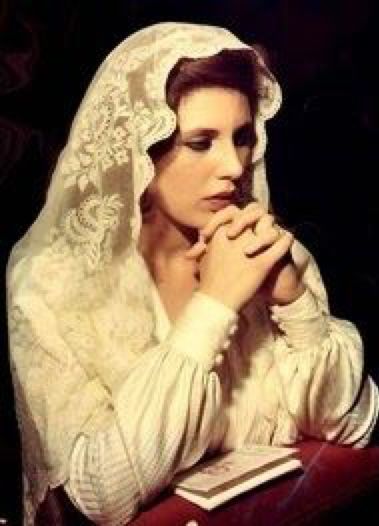
It’s been a little over four years since I became a Christian and two since I was baptised. Even before I converted, I was always drawn to the practice of veiling.
As a child, my first exposure to veiling was seeing a woman wearing a white veil with her wedding dress, or a woman wearing the hijab (I grew up around a large Muslim community). On TV and in films, I would see some Catholic women wearing a beautiful lace veil during Mass. As I grew older, I began learning about religious headcovering among Jewish and other denominations of Christian women. In primarily Orthodox Jewish women, I would see tichels (scarves) and sheitels (wigs) being worn by married women. In Christian women, I would see the mantilla, headscarf in Eastern and Oriental Orthodox, and doily-like covers clipped to the back of the hair in Mennonite circles.
I always found the tradition of headcovering fascinating. I thought lace veils in particular beautiful, and I thought the ladies who wore them looked beautiful and feminine. Something really stuck with me about covering one’s head as a sign of devotion and respect in a place of worship. I was fascinated by the different styles of headcoverings. Being a lover of scarves, I would practice some of them in the privacy of my own room for the sheer enjoyment and curiosity of it.
If and how a woman chooses to cover her head should be her decision and hers alone, regardless of religion or culture. I’m a firm believer in choice, and do not believe that because I personally veil in church, others should too. Veiling is a deeply personal thing and should be treated as such. I had been discerning wearing the veil for at least a year, veiling on and off, before deciding to properly don it in church.
There are many different reasons why a woman might veil in church. Here are mine:
THE TRADITION
I love that veiling has been a tradition for thousands of years, often predating the origins of the major religions that practice veiling today. I love that, while it may not be as common as it was, it still stands the test of time. I class myself as “liturgically traditional, socially modern” in how I practice my faith. And being an Anglo-Catholic (one of the many traditions within the Anglican Communion), we Anglicans believe in Sacred Scripture (the Bible), Church Tradition, and Reason, similar to a Triangle diagram.
In Anglicanism, head covering isn’t as common as say in Catholicism or Orthodoxy (and it’s not even as common in Catholicism as it used to be, but appears to be making a comeback). But those who do may wear hats (in the UK, it was most common back in the day for a woman to wear a hat in church)1, a bandana style covering, or a headscarf or veil, depending on your country and/or culture. Veiling is one of many ways I feel more connected to God and the sacred traditions that have been passed down for over two thousand years. That, and feeling more connected with my Catholic and Orthodox brothers and sisters.
REVERENCE AND HUMBLING YOURSELF
To me, even before finding my faith, I always saw veiling in church as a sign of reverence. While I didn’t grow up in the church, I spent a lot of my childhood exploring churches due to my mother’s genealogy hobby. Upon learning more about our ancestors, we actually visited many of the places they were either baptised, married, or buried. So I spent many weekends being taken to churches in local villages or in my hometown. Like any parent, my mother would reiterate to my sister and me to be on our best behaviour and, of course, considering these churches are centuries old, not to touch anything. While we weren’t a religious family, we were in a place of worship, so we’d treat it with the respect it deserved.
Now, as a convert, that takes on a much deeper meaning. As well as showing respect to a centuries-old building packed with history, I am in God’s house. No matter one’s status outside, we are all equal in God’s eyes, as we should treat one another in everyday life. Combined with my love for the tradition and beauty behind veiling, veiling signifies a sense of humility to me. I’m not trying to say, “Look at me, I’m more pious than you because I cover my head.” Quite the opposite, actually. There are many ways people of faith try to humble themselves before God. For some, it’s wearing simpler clothing. For others, it’s genuflecting or completely prostrating oneself in the presence of the Eucharist, or while venerating an icon (like our Orthodox friends do). For me, one of the ways I try to humble myself before God is by veiling.
DONNING THE VEIL
When I decided to return to church after some time away, I made the decision that I wasn’t going to worry as much about sticking out. I’d spoken to a few clergy from different backgrounds about the veil, all of whom said it wasn’t very common anymore, but ultimately it is the decision of the individual. One suggested sticking to a hat if I was worried about sticking out like a sore thumb (which I was at first). After a little while of experimenting with a regular scarf (which I found to be too long and too hot in the summer), I decided to take one of the veils from my drawers.
I’d bought it online, and it sat in my bag as I went to church on a late summer Sunday last year. While anxious that I would stand out, worrying if others might think I was pulling a “holier than thou” move, I remembered all the reasons why I wanted to wear it in the first place: for God. To show reverence and embrace that devotion in my own personal way. So, despite my anxieties, I took it out of my bag and put it on, and the rest is history.
FALLING DEEPER IN LOVE WITH THE VEIL
Since I’ve been practicing my faith more in everyday life, by reading the Bible, praying etc. especially when in church and receiving the Eucharist, I have begun to fall deeper in love with veiling. Veiling continues to be a devotional that helps me fall deeper in love with my faith. There’s a sense of completeness I feel when I’m in church, wearing my head covering, and especially so when receiving the Eucharist. I feel a much deeper reverence when receiving communion. I also feel more connected and unified with Christians across all denominations. While yes, there are differences that sadly, people will fight over (which is really unnecessary, in my opinion), many (outside of the internet, anyway) pray for greater community. To remember that we’re all there for the same reason: Jesus.
*Image credit – Pexels
 Becoming Violet Grey